


A bookcase can look spacious online but turn out too deep, too short for folders or awkward to place because of a skirting board. Avoid guesswork after delivery: list what needs storing, measure the wall and check the route. Choose storage that works without overwhelming the room.
List what you plan to store
Gather representative items: large books, paperbacks, binders, photo books and décor. Measure the largest pieces in all dimensions. The outside size of a case does not tell you how much usable shelf space it offers.
Decide whether you want to display books, conceal items behind doors or combine both. Open shelves keep things visible; closed storage can create a calmer look. Choose the balance for your routine, not just the photograph.
Measure the wall, skirting and obstacles
Measure wall width and ceiling height and note skirting boards, sockets, radiators, sills and switches. Check that room and cabinet doors can open. Leave room for assembly and positioning.
Measure at several heights. A skirting board can keep a cabinet off the wall and make the top project farther than expected. Tall furniture should be placed safely and secured to the wall if instructed. Follow the manual.

Choose depth based on your belongings
Compare usable shelf depth with your largest book or folder. Allow for projecting covers and how you want books to stand. A shallow shelf may suit novels but not wide binders or art books.
A deeper unit may add capacity but also takes floor space and can narrow a walkway. Mark the full depth with tape and walk past it. Check whether listed depth is an external or usable internal measurement.
Plan shelf height and adjustability
Adjustable shelves can help you adapt the layout. Check how many positions are available and whether every shelf can move; do not assume adjustability unless it is stated.
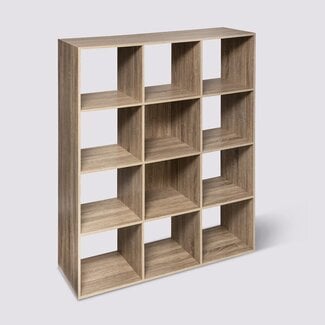
Count how many tall spaces you need for folders and larger books, then leave shorter spaces for paperbacks and small items. Too many tall shelves waste space; too many short ones limit use.
Check stability, loading and assembly
Review any stated load limit per shelf and for the whole unit. Distribute heavy books as directed and use fixings suitable for your wall. Wall types differ, so choose the correct fixing for the surface.
Assemble tall furniture as instructed and do not skip required wall restraints. Check that it stands level on a stable floor. This is general planning guidance, not a substitute for maker instructions.
Plan delivery and positioning
Measure doors, stairs, lift, hallway turns and the assembly area. Check whether the package and loose parts can pass through. Note whether self-assembly is required and how much room you need.
Prepare tools and protect the floor. Do not fill the unit until it is properly assembled and level. Check current dimensions and assembly details on the product page before ordering.
Frequently asked questions
How deep should a bookcase be?
It depends on the largest books and folders you plan to store. Measure them and compare with usable shelf depth.
Should a tall bookcase be secured to the wall?
Follow the manufacturer’s assembly and restraint instructions and use fixings suitable for your wall.
Can I fill it before assembly?
No. Assemble and position furniture as instructed and follow stated load limits.


Comments (0)