


Choosing a bar stool online by colour and style seems easy—until your knees hit the counter or your feet have nowhere to rest. Do not guess based on a “standard height”. Measure your island or bar table and the available space so you can compare both fit and everyday comfort.
Measure from the floor to the underside of the counter
Measure the floor to the top of your island, but do not forget the underside. A thick edge or support rail can reduce knee space. Note the overhang depth too: you need room for your legs, not just a place to sit.
Measure more than one point if the floor or counter is uneven. Include drawers, handles or front panels. This helps prevent a stool that seems to fit on paper but cannot slide under the counter.
Compare the seat with the available clearance
Check the seat height in the product details against the distance from floor to counter underside. Your thighs need clearance to sit comfortably. There is no single measurement that works for every person, stool and counter, so test with your actual chair or a temporary seat.
Retailers may show both overall height and seat height. Seat height is key for fit; overall height helps you see whether the stool fits under a shelf or counter. Check which measurement is which.
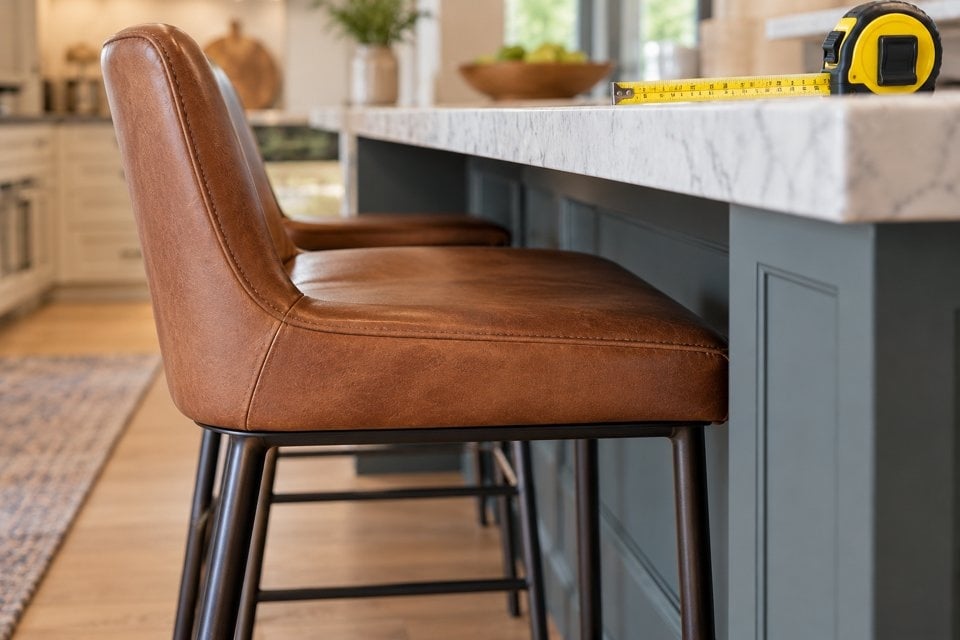
Check the footrest and stool design
A footrest can make longer sitting more comfortable, especially on taller stools. Check its position against your leg length. A backrest may offer support but usually takes more room and can limit how far the stool tucks in.
Swivel or adjustable designs add flexibility, but check the base, turning space and armrests. In a compact kitchen, a simple stool that tucks away fully may be more practical.
Work out how many stools really fit
Measure usable counter length rather than dividing by an arbitrary width. Allow for the widest point of the stool, armrests and room to move. Temporarily place boxes or chairs side by side and check whether people can sit and stand together.
Consider cabinet and drawer doors too. A row of stools may block the walkway when not in use. Check that they can be tucked in and the route remains clear.

Choose materials for everyday use
Choose a finish that suits how often the stools are used and cleaned. Check care instructions and the stated load capacity on the product page; do not infer features from a lifestyle photograph. With upholstery, seams and cleaning access are practical considerations.
Think about children, pets and spills. Easy cleaning may matter more than a specific shade. Check the manufacturer’s stated load limit and assembly information.
Try a simple mock-up
Use a sturdy box or temporary seat at the intended height and sit at the counter. Notice your knees, feet, shoulders and how easily you stand. This cannot guarantee every stool will fit, but it helps identify the position you find comfortable.
Then compare seat height, overall height, width, depth and footrest. Ask for missing measurements before ordering. Measuring is more reliable than guessing that a height “looks about right”.
Frequently asked questions
How much clearance should there be between seat and counter?
It depends on the user, seat and counter shape. Measure the available clearance and test a similar seat rather than relying on one universal figure.
Is overall height the same as seat height?
No. Overall height reaches the highest point; seat height is measured from floor to seat. Check both specifications.
Will any bar stool fit a kitchen island?
No. Measure underside, overhang and obstacles, then check seat height, width and footrest.


Comments (0)