

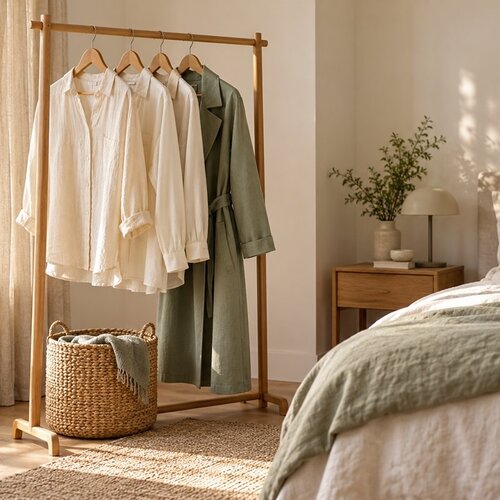
A clothes rack makes it easy to see what is hanging, but choosing one starts with your garments and available space. Measure the hangers and clearance around them too. A slim frame can take up much more depth once coats are hanging on it.
Start with the clothes
Gather the garments you actually want to hang. Measure the longest item from the hanger hook to the hem. Then measure your widest loaded hanger, perhaps carrying a coat. This tells you more about required height and depth than the frame measurements alone.
Estimate how much rail space you need as well. Thick coats take up more width than light shirts. A photograph showing five widely spaced hangers cannot show how much room your own wardrobe requires.
Measure the space with garments in place
- Mark the base or frame footprint on the floor.
- Hold a loaded hanger where the rack will stand to judge actual depth.
- Check doors, cupboards, curtains and everyday walking routes.
- Measure clear hanging height above any shelf or shoe platform.
- Allow room to stand while removing clothes.
For example, a frame 35 cm deep may fit a recess even though your loaded hangers are wider than the recess. The clothes then project beyond it. This figure is only a measuring example: use your own hangers.

Compare each load limit
Check the rated load for the rail, shelves and complete rack. An overall limit is not automatically the allowance for every shelf. Distribute clothes and follow the assembly and use instructions. Adjustable and fixed rails may have different stated limits.
If capacity information is missing and you want to hang heavy coats, ask before ordering. The material or a sturdy appearance alone does not establish the strength of the assembled structure.
Shelves, double rails or wheels?
A bottom shelf can hold baskets, but may reduce clear hanging length. Two rails can organise shorter clothes when their spacing works. Long dresses and coats instead need uninterrupted height.
Wheels can help if the rack needs moving regularly. Consider flooring, thresholds and brakes, and follow the instructions for moving it while loaded. A design that looks airy in a photograph may be harder to turn in a furnished room.
Keep the arrangement useful
Give daily clothing its own section rather than making the rack temporary storage for everything. Review the actual contents against the space available. A larger model is not the only answer: an organised layout and clear access are often more useful in daily life.
Frequently asked questions
How deep should a clothes rack be?
Consider whichever projects further: the frame or the loaded hangers. Clothing can extend beyond the base. Measure the real arrangement and include walking clearance.
Is a double rail always better?
Only when the height and spacing suit your garments. Two short zones are less useful for long items. Compare usable hanging space, rather than just counting rails.
Can I move a fully loaded rack?
Follow the instructions for that model. Wheels do not automatically mean every load can be rolled over thresholds safely. Check brakes and distribute the contents.
What measurements help when asking for advice?
Provide available width, depth and height, the length of your longest garment and a photograph of the space. Include obstacles and whether you plan to move the rack.


Comments (0)