

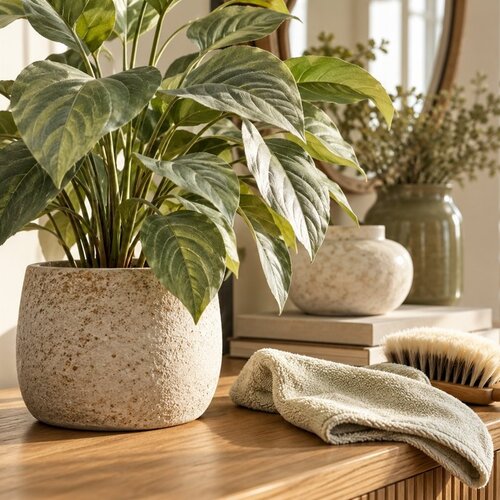
Artificial plants need no watering, but their leaves and pots can collect dust. Begin with the gentlest method: careful dry dusting. Plastic, fabric, coatings and glued parts do not all respond in the same way to moisture or cleaning products.
Check materials and care guidance
Read the product information and care label first. Flexible plastic leaves, fabric foliage, decorative moss and weighted bases can require different treatment. A washable-looking surface does not mean the entire plant can be soaked.
Place the plant on a protected surface. Look for loose leaves, delicate stems and the way it is fixed into its pot. Move a large model by its container or base as instructed, rather than lifting it by the branches.
Remove loose dust
- Use a clean, soft dry cloth or a gentle dusting brush.
- Work from the top down so dust does not settle on cleaned leaves.
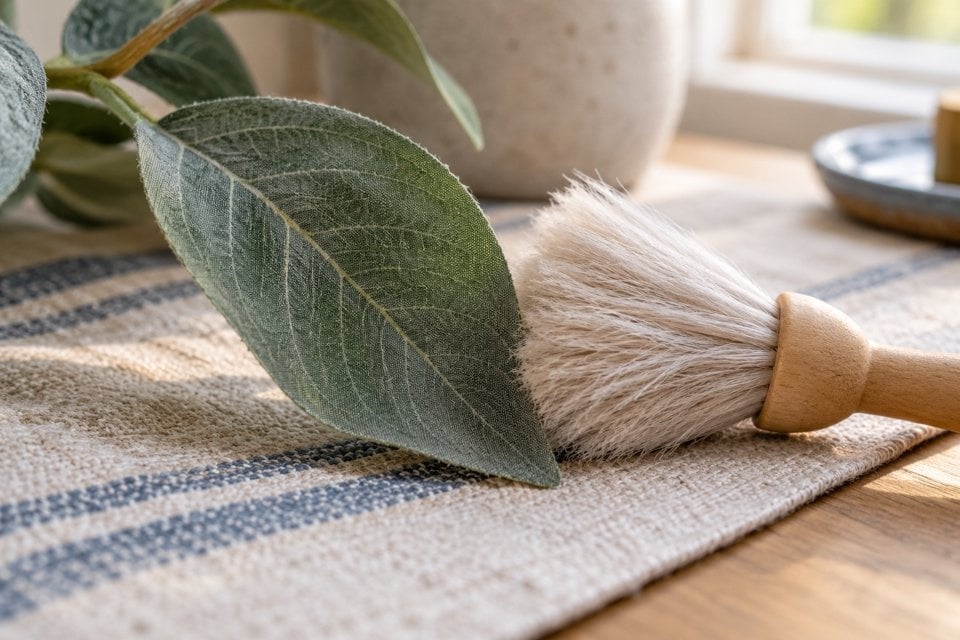
- Support each leaf with your other hand without forcing its shape.
- Take care around veins and closely spaced branches.
- Clean the pot and surface separately, then check the result in daylight.
When is a damp cloth suitable?
Use one only when the product’s instructions allow it. Test an inconspicuous area first and check for changes to colour or coating. Use minimal moisture, keeping glued joints and the pot filling dry. Let everything dry completely.
Do not automatically apply glass cleaner, vinegar, leaf-shine spray or fragrance. Hot hairdryers, steam cleaners and strong jets of water are not universal care methods either. When uncertain, gentle dry dusting is the cautious starting point.
Build a small care routine
Identify the places that hold dust: wide leaves, fine branches or the top of the pot. Choose a soft tool for the area. A large cloth can be awkward among tiny leaves, while a little brush is slow across broad surfaces. Work without repeatedly bending the plant.
Treat mixed materials separately. A ceramic container may need different care from a leaf coating. Check the underside of the pot and any furniture protector as well, so moisture is not left against the cabinet after cleaning.
Check before you finish
Look closely, then view the plant from its usual viewing distance. Remove visible dust from edges, but do not try to scrub away every variation in colour: some are part of the design. Stop if colour transfers, a joint loosens or the finish changes, and review the care guidance.
Frequently asked questions
Is every green surface made of plastic?
No. Artificial plants can combine fabric, plastic, coatings and other components. Appearance and colour are not enough to choose a cleaning method. Check the product information.
Can I use a cleaning solution?
Only when the care instructions allow it for the material. Do not use a homemade mixture as a universal treatment. Test any approved method on an inconspicuous area first.
Can I use a vacuum cleaner?
Do not assume the construction can withstand suction. Loose or delicate parts may be strained. Check the guidance; a soft dry cloth or brush is the cautious first step.
Can I put the cleaned plant outside?
Cleaning does not change outdoor suitability. Check separately whether the whole product is intended for outdoor use. Cleaning an indoor plant does not make it weather resistant.


Comments (0)