

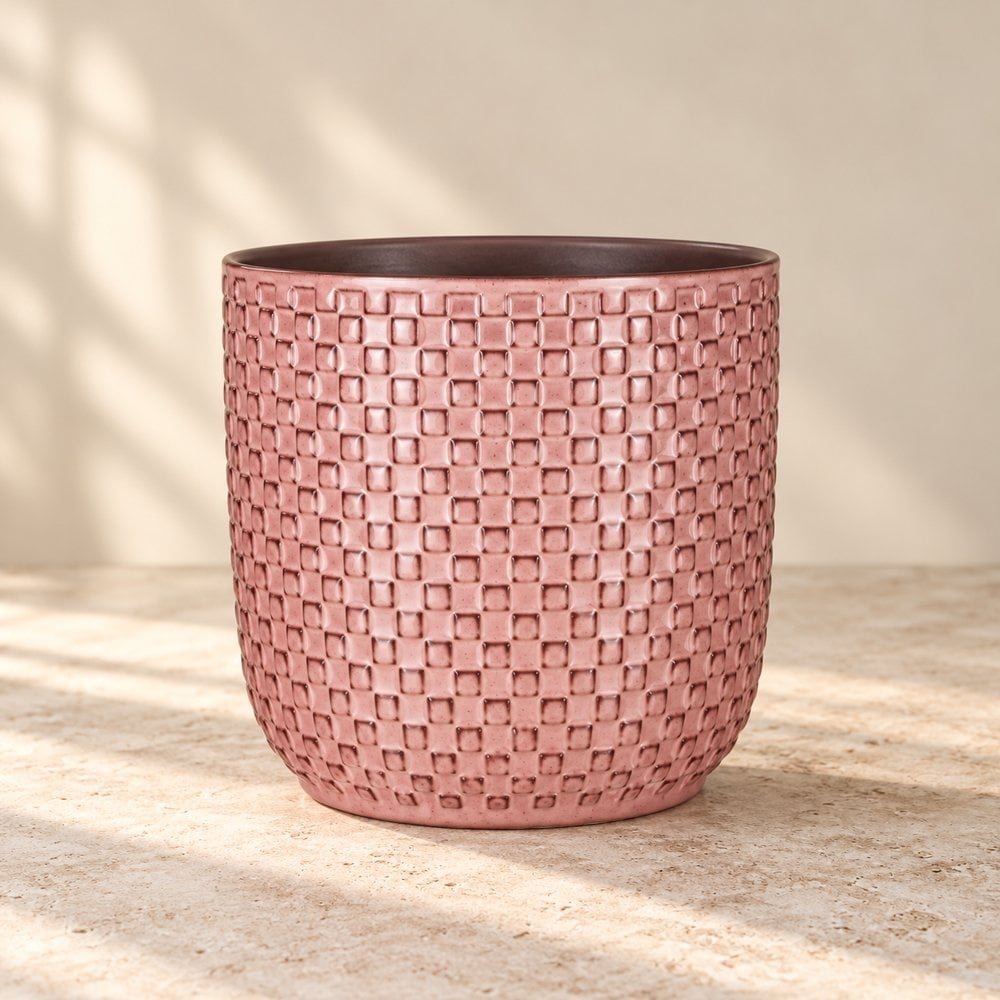
What size plant pot do you need? A measuring guide
Choose a cover pot using its internal measurements, not its outside diameter alone. The nursery pot must pass through the opening, fit inside at the required depth and remain easy to remove. If you are repotting into fresh compost instead, assess the rootball and the new growing container.
Two pots can carry the same size number and still fail to fit together. A few measurements are more useful than assuming that a larger-looking photograph means more usable space.
Which kind of pot are you choosing?
- Nursery pot: the container supplied with the plant, often with drainage holes.
- Cover pot: a decorative outer container for the nursery pot.
- Growing pot: a container used for planting directly into compost.
Changing a cover pot does not mean you must repot the plant. Keeping the nursery pot makes the choice mainly a question of fit.
Take four measurements
- Measure the widest part of the nursery-pot rim, including any projecting lip.
- Measure its complete height from base to rim.
- Check the cover-pot opening.
- Check the usable internal depth and width, allowing for tapered sides and a thick base.
A rounded cover pot may have a wide middle but a narrow opening. A tall outer container can also be shallow inside. If the listing gives only external dimensions, ask for the missing internal measurements.
Example: a 12 cm nursery pot
Imagine your nursery pot is 12 cm wide at the rim and 11 cm tall. A cover pot with a 12 cm external diameter is not automatically suitable. Another pot with an opening of 13.5 cm and usable depth of 12.5 cm may work, but you still need to check the internal taper. These are example measurements, not a universal rule for all pots.
| Listing detail | Your next check |
|---|---|
| Plant pot size: 12 cm | Measure the supplied nursery pot and its rim. |
| Cover pot: 14 cm external | Ask about the opening and internal space. |
| Cover pot: 14 cm internal | Also compare usable height and shape. |
Buying a pot for actual repotting
Bigger is not automatically better. RHS guidance explains that a large volume of fresh compost can stay wet around a small rootball. Select a modest step up when repotting is needed, and use species-specific advice.
Water must be able to drain from a growing container. With a closed decorative cover, an inner nursery pot lets you water and drain the plant separately. Check for water left in the outer pot afterwards.
Frequently asked questions
Which cover pot fits a 12 cm plant pot?
One whose measured internal space accommodates your actual nursery pot. The size number alone cannot confirm that fit.
Should a new houseplant be repotted immediately?
Not merely to change its appearance. Check the roots, plant condition and care guidance first.
Can I use a pot without drainage holes?
As a cover for a removable inner pot, you can drain the plant separately. Do not leave collected water in the bottom.
Browse plant pots and houseplants, comparing the nursery-pot dimensions with the real internal measurements of each cover pot.


